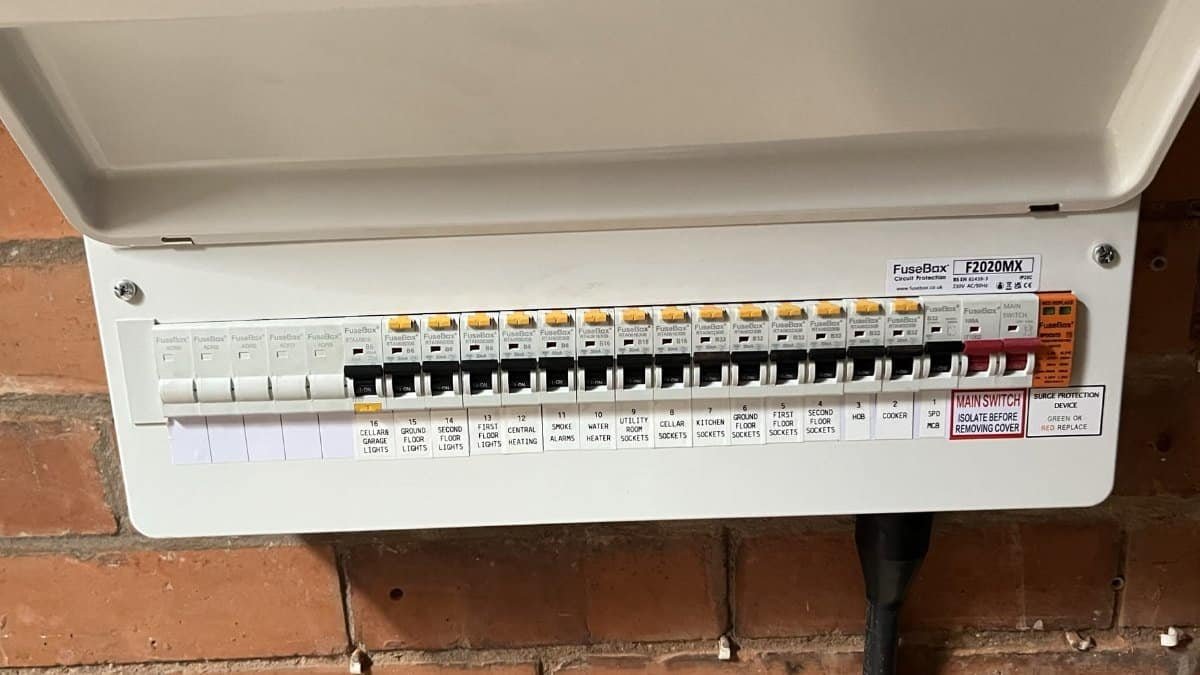
If your electric keeps tripping, a safety switch in your fuse box (also called a consumer unit) has spotted a problem and cut the power. People often call it the trip switch. That’s the switch doing its job. It’s more likely to be a faulty appliance than your wiring, but it can also be too much running on one circuit, damp or the switch itself.
When a fuse box keeps tripping, the switch that has gone tells you a lot. Start there. There are a few more safe checks you can do before you call anyone.
Don’t reset it, and call an electrician, if:
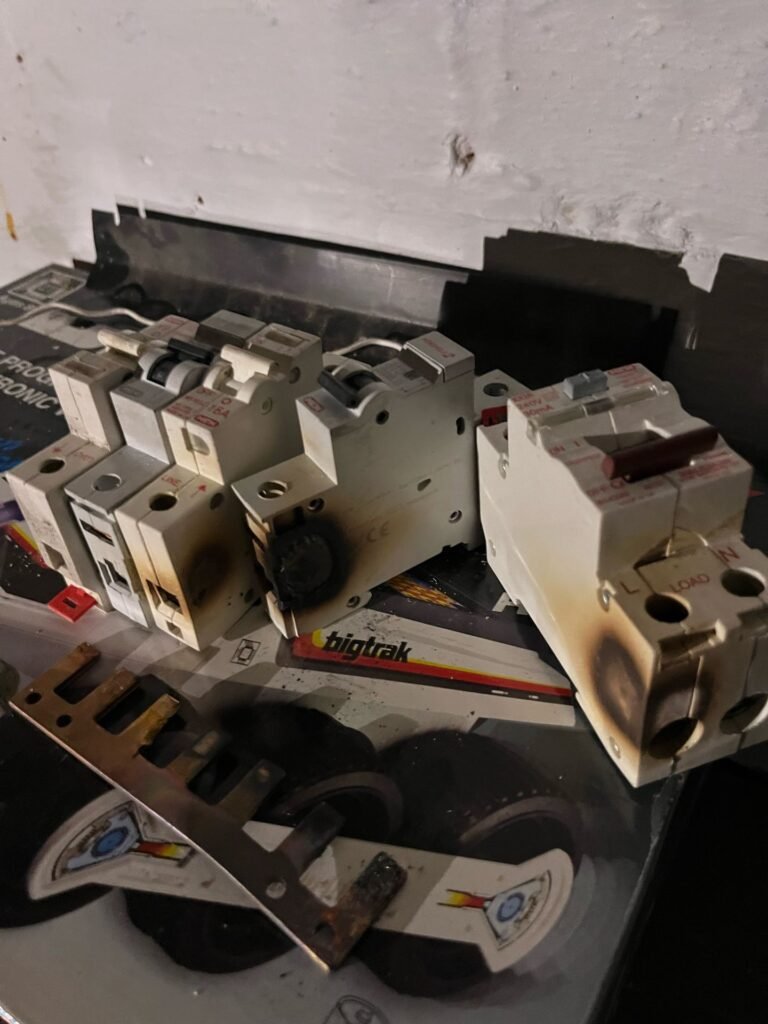
- you can smell burning, or see scorch marks or smoke
- you can hear buzzing or crackling from the fuse box, a socket or a switch
- a plug, socket or the fuse box has been getting hot
- there’s water in or near the fuse box
- someone has had an electric shock, however small
If it’s safe to do so, switch everything off at the main switch. If there’s smoke or fire, get everyone out, stay out and call 999. Otherwise, leave it switched off and call a registered electrician. You can reach us on 07922 110678.
If someone is getting a shock right now, don’t touch them. Switch off at the main switch or pull the plug out, if you can do it safely. If they’re unconscious, call 999. If they seem fine, keep an eye on them, because Electrical Safety First says the effects of a shock aren’t always obvious straight away. The NHS says any burn caused by electricity needs 999 or A&E.
First, Check Which Switch Has Tripped 🔍
Find your fuse box and look for a switch in a different position to the rest. One that has dropped down to OFF has tripped. Each switch should have a label saying which circuit it covers, such as the kitchen sockets or the upstairs lights.
If nothing in the fuse box has moved and the whole house is off, it may be a power cut. Ofgem says you can report one for free on 105.
One switch is down and one area is off: a circuit breaker (MCB)
That’s usually that circuit’s breaker, often called an MCB. There’s one per circuit, and it switches off when too much current flows, because the circuit is overloaded or there’s a short circuit. On newer boards it may be an RCBO instead (see below), which can also trip when current leaks to earth.
A switch with a Test button is down and several areas are off: an RCD
That’s an RCD (residual current device). Many fuse boxes have two, each covering a group of circuits. An RCD protects people from electric shock. It’s rated in milliamps (thousandths of an amp), not amps, and the IET, who publish the Wiring Regulations with BSI, say that makes it thousands of times more sensitive than a breaker. It trips when some current leaks away to earth instead of flowing back round the circuit, through damp, a damaged cable or a faulty appliance. If one RCD takes the whole house off, you may have an older board with a single RCD over everything.
That’s the difference between an RCD and an MCB. A small leak is nowhere near enough to trip a breaker, but it’s plenty for an RCD. That’s why, when an RCD keeps tripping, the breakers under it often stay on.
Your board has RCBOs
An RCBO does both jobs in one switch, one per circuit, and has its own Test button. So if a switch with a Test button is down but only one area is off, it’s probably an RCBO. It could be too much current or a leak to earth, so the unplug test below still applies.
You have an old fuse box with fuses
A fuse blows rather than trips, usually for the same reasons. Changing a fuse means working inside the fuse box, so please leave that to an electrician. Our guide on whether your fuse box needs upgrading explains what to look for.
How to Find Out What’s Tripping Your Electric, Step by Step ✅
These steps follow the IET’s advice for homeowners.
- Find the switch that’s down. If it’s a switch for one circuit, read its label. If it’s an RCD, note every room or area that lost power.
- Unplug everything in the areas that lost power. Pull each plug right out. The IET says switching off at the wall isn’t enough.
- Reset the switch by pushing it back up to ON.
- If it stays on, plug things back in one at a time, switching each one on before you move to the next.
- If it trips when one item goes on, that item is the likely cause. Leave it unplugged, reset the switch again and don’t use that item until it’s been checked or repaired. If a lot was running on that circuit, it may just be the one that tipped it over, so tell your electrician what was on.
- If it won’t stay on even with everything unplugged, stop. The IET warns that resetting onto a fault again and again can damage the switch. A registered electrician needs to test the installation to find the fault. That’s what our electrical fault finding visit is for.

If only the lights went off just as a bulb went pop, the IET says the bulb could be the cause, though that’s more common with old-style filament bulbs. Reset the lights switch in the fuse box. If it trips again, leave it off and give us a call.
Common Reasons It Keeps Tripping ⚡
A faulty appliance
The IET says a trip is more likely to be a faulty appliance than a fault in the wiring of your home. The unplug test above is how you find it.
Too much on one circuit
An overload trips a circuit breaker (or an RCBO), not an RCD. NICEIC says plugging several high-powered appliances into one socket through an extension lead can cause one. Electrical Safety First says overloading a socket or lead is also a fire risk, and plugging one lead into another can overheat the plug in the wall, so never do it. Their socket overload calculator helps you check.
Damp or water getting in
Damp lowers the insulation around the wiring, so a little current leaks to earth and the RCD trips. Wet plaster, condensation and water getting into sockets or fittings can all do this.
Lots of small leaks adding up
Computers, printers, washing machines, tumble dryers and lots of other appliances can each leak a tiny amount of current to earth in normal use. On one RCD those amounts add up, and an RCD is allowed to trip at anything over half its rating, so it can go off with nothing actually broken.
A fault in the wiring
This is less common, but the IET says it’s more likely after DIY, such as hanging pictures or shelves, where a nail or screw can catch a cable. Wiring can also work loose or get damaged over time. Finding a damaged cable takes testing, so leave this one to an electrician. Our guide to the signs your house needs rewiring covers other things to look out for.
A faulty or damaged switch
An RCD can fail, which is why it has a test button (more on that below). It can also be too sensitive and trip when it shouldn’t. An electrician can check that with what’s called an RCD ramp test.
Why Does My Electric Keep Tripping When Nothing Is Plugged In? 🔌
Because some things are wired in rather than plugged in, so they stay connected even when everything is off at the sockets. That includes the lights, an electric shower, a cooker or hob, an immersion heater and outside lights. Cooker heating elements can also have lower insulation when they’re cold, which can be enough to trip an RCD.
If it still trips with every plug out, it could be the wiring, something wired in, damp or the switch itself. That needs an electrician to test.
Why Does My Electric Trip When It Rains, or at Night? 🌧️
Tripping when it rains
Rain can get into outdoor sockets, outside lights and garden cables, or soak into walls, and let current leak to earth. If it trips whenever it rains, please don’t open up outdoor fittings to dry them out. We can check your outdoor sockets and lights. Surges on the supply, including lightning, can trip an RCD too.
If water has got into the fuse box, Electrical Safety First’s advice is to switch off there only if it’s safe to do so, and not to use mains appliances until a registered electrician says it’s safe.
Tripping at night
A trip at night can have any of the causes above. What changes is what’s running: heating, hot water, fridge-freezers and outside lights on sensors can all switch on by themselves. Note the time and what might have been on, and tell your electrician.
Is It Dangerous if a Circuit Breaker Keeps Tripping? ⚠️
If your power keeps tripping, the trip itself isn’t the danger. That’s the safety switch working. The danger is whatever caused it. NICEIC lists a breaker or RCD that keeps tripping when you use a socket among the signs of a dangerous fault that could lead to shocks or fires, and Electrical Safety First says to get a registered electrician to check your electrics as soon as possible.
If you ever see burning or scorch marks at the fuse box, the IET says to switch off at the main switch, if it’s safe, and call a registered electrician.
It can be a fire hazard if the cause is left. The government’s Be Ready campaign says faulty electrical appliances cause thousands of fires in the home each year.
Test Your RCD Every Six Months 🔘
Press the button marked “T” or “Test” on each RCD (or on each RCBO, if your board has one per circuit). It should switch off and cut the power to those circuits. Then push it back up to ON. If it doesn’t switch off, the IET says to get a registered electrician to look at it.
The IET says to do this every six months, and the label on your fuse box should say how and when (older labels may say every three months). Doing it when the clocks change makes it easy to remember. Save anything you’re working on first, because everything on that RCD goes off.
No Test button at all? You may not have an RCD. Electrical Safety First says an older fuse box without one isn’t necessarily unsafe, and an electrical inspection (EICR) will tell you where you stand. In the meantime, they say to use plug-in RCDs for the sockets in your home. If it does need replacing, we can help with a consumer unit (fuse box) upgrade.
When to Call an Electrician, and What They’ll Check 👷
Give us a call if:
- the unplug test hasn’t found what’s tripping it
- it won’t reset with everything unplugged
- the RCD doesn’t switch off when you press Test
- a fuse has blown in an old fuse box
- you’ve noticed any of the warning signs at the top of this page
To find the fault, an electrician tests the wiring. One test, called an insulation resistance test, checks whether current can escape through damaged or damp insulation. Another uses a clamp meter to measure leaking current, first circuit by circuit and then appliance by appliance. If lots of small leaks are adding up on one RCD, splitting the circuits differently or fitting RCBOs can help.
Tell us which switch tripped and what was running at the time, and we’ll explain what we find in plain English. And if your home hasn’t had an electrical inspection (EICR) in years, Electrical Safety First suggests one at least every 10 years for a home you live in. If you rent it out, it’s at least every five years, and in England that’s the law.
Frequently Asked Questions ❓
How do I stop my electric tripping?
Find the cause with the unplug test, then get any faulty appliance repaired or replaced. If it’s overloading, don’t run high-powered things like kettles, irons and heaters off one socket or extension lead, or all at once on the same circuit. If it isn’t an appliance, a registered electrician needs to test the installation.
Why is my RCD tripping but not my circuit breaker?
A breaker trips on too much current. An RCD trips on current leaking to earth and is far more sensitive, so a small leak from damp or a faulty appliance can trip the RCD and leave the breakers on.
Why does my RCD keep tripping?
An RCD trips when it senses current leaking to earth. It’s often a faulty appliance, but damp, lots of small leaks from appliances adding up, damaged wiring or a faulty RCD can also do it. If it trips when one particular circuit is switched off, tell your electrician which one.
Does a breaker need replacing if it keeps tripping?
Not usually. Most of the time it’s doing its job, and the fault is more likely to be in an appliance than your wiring. A switch can fail, though, and an electrician can test it, so please don’t swap anything in the fuse box yourself.
Why does my electric keep tripping after I reset it?
If it trips the moment you push it back up, the fault is still connected. Only reset it after you’ve unplugged everything on that circuit, and keep resets to a minimum, because the IET says repeated resets onto a fault can damage the switch. If it trips straight back with everything unplugged, leave it off and call a registered electrician.
Is it safe to use the electrics after a trip?
Usually, yes, as long as the switch resets and stays on, you’ve found and unplugged the item that tripped it, and there’s no burning smell, scorch marks, heat, buzzing or water near the fuse box. Don’t use that item until it’s been repaired. If it trips again, won’t stay on, or you couldn’t find what caused it, leave that circuit off and call a registered electrician.
Need a Hand Finding the Cause? 📞
We’re Electric-Cal Solutions, a NICEIC Domestic Installer based in Worksop and run by Callum Beard. We work across Nottinghamshire, South Yorkshire and Derbyshire, including Worksop, Retford, Sheffield, Rotherham, Doncaster, Chesterfield and Mansfield.
If your electric keeps tripping and you can’t work out why, we can come and find the fault for you. Send us a message through our contact form, or call 01909 261231 or 07922 110678.